Monthly Archives: March 2011

Celebrating the Life of Norm Schureman

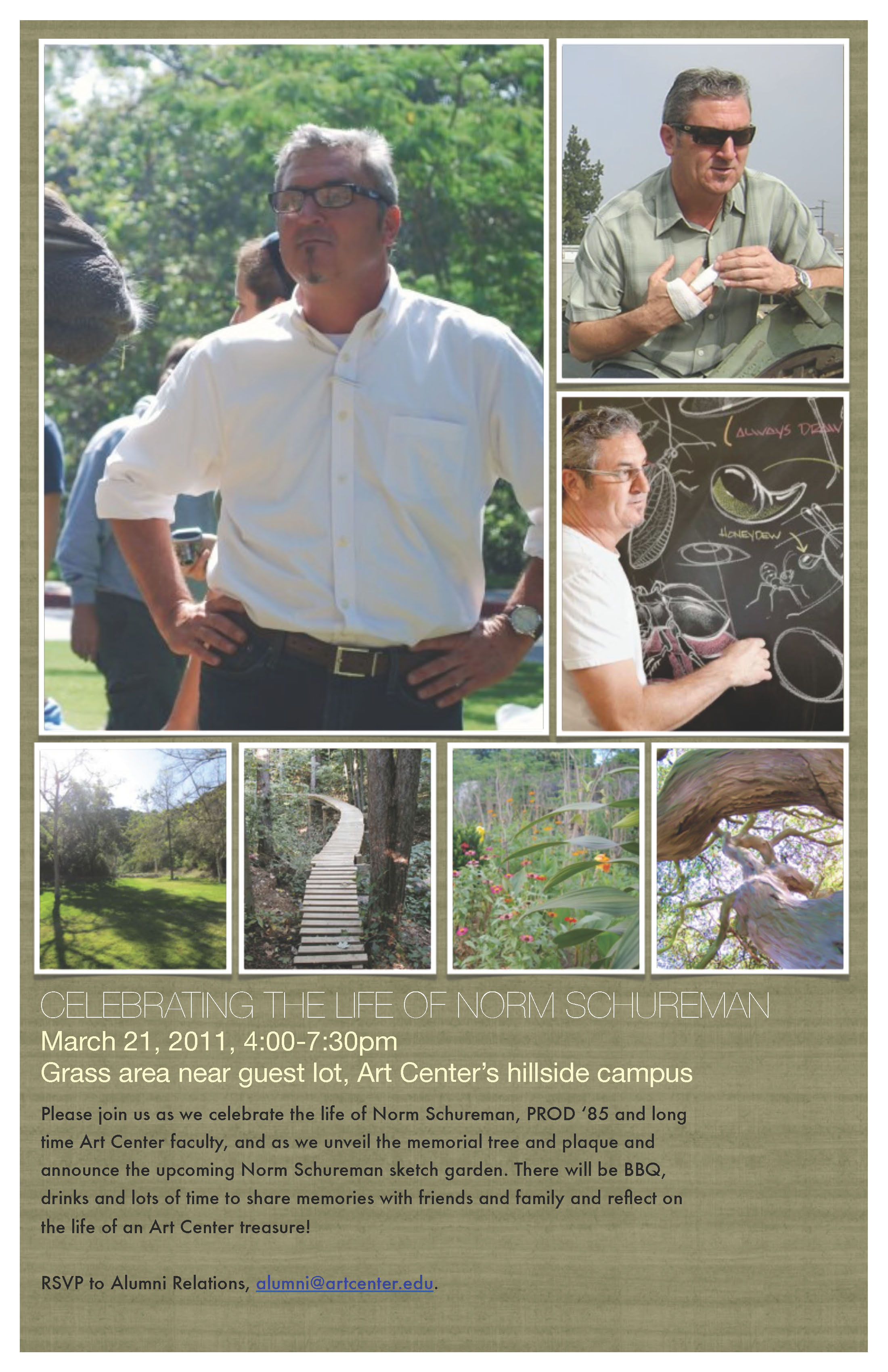
Please join us this Monday as we celebrate the life of Product Design alumnus and faculty member Norm Schureman, unveil his memorial tree and plaque, and announce the upcoming Norm Schureman Sketch Garden.


There will be barbecue, drinks and lots of memories shared with Schureman’s family, friends, colleagues and students.

RSVP to alumni@artcenter.edu. Also, don’t forget the design charette to design the sketch garden on Saturday, March 26.

Celebrating the Life of Norm Schureman
Monday, March 21, 4-7:30 p.m.
Art Center Hillside Campus
Grassy area near the guest parking lot
RSVP: alumni@artcenter.edu

Creating Our Future Through Art Center’s Strategic Plan


What does the great art and design school of the 21st century look like? How can it best serve its students?

Last year, the Art Center community came together to find out. Through an all-inclusive visioning process, we addressed the challenges of making our distinctive education cutting-edge and pertinent—the what, where and why—and envisioned Art Center’s future.

The result of this process is Art Center’s 2011-2016 strategic plan, unveiled last week to the College community. The five-year plan both honors Art Center’s distinguished 80-year history and imagines its future.  It shapes our core values into a new model for art and design education for the 21st century—one that ensures continuing excellence, relevance and impact for decades to come.

We sat down with College president Lorne Buchman to find out more about the strategic plan, how it came about, and what it means to the Art Center community.

Dotted Line: Why was it important to involve the entire Art Center community in the visioning process?
Lorne Buchman:
Art Center has a reputation for being incredibly rigorous with our students—it’s key to the quality and the kind of education that we offer. One of the wonderful things about the planning process was that it was a chance for us as an institution to be as rigorous with ourselves as we are with our students.

In coming up with this strategic plan, we felt it was really important that everyone—alumni, students, faculty, staff, Trustees—participate in the planning process that culminated in the plan. The College is filled with brilliant, creative, wonderful people who care deeply about this institution, and who have the power to design their future. The spirit of this planning process proceeded as such.

Dotted Line: And a new College mission statement came out of the process as well?
Buchman:
Yes. I’ve never loved a mission statement, but I love this one: “Learn to create. Influence change.” It’s such a profound educational philosophy, and what our College is about.

Dotted Line: Why was a strategic plan necessary?
Buchman:
There is a new ecology of learning going on. Higher education is changing incredibly rapidly. Our students are changing—they’re different than they were five, even 10 years ago. We must be attuned and responsive to these things.

Dotted Line: In what ways have students changed?
Buchman:
Our students are coming to us with a real kind of social consciousness.  I think the success of Designmatters demonstrates this rather well. Students are coming to Art Center with the goal of finding meaningful work after graduation. They understand that what they do as artists and designers has ramifications for all communities and corners of the world. They can lend a way of thinking, creating, solving problems and addressing issues. That’s very deep and profound, and it opens up a new kind of knowledge. It’s our duty to help them in this pursuit.

Dotted Line: One of the plan’s key pillars is the Conservatory Spirit, which isn’t a term one usually applies to an art and design school. Can you elaborate?
Buchman
: The idea of Art Center as a conservatory has its roots in the school’s history. This has always been a place that prepares students for creative and career success. Akin to Juilliard, we provide the highest caliber of education, we employ a professional faculty who bring a sense of real-world relevance to the classroom environment and we offer programs that meet the demands of society—all to ensure artists and designers have a place in the world. This is where the conservatory spirit comes from.

Continue reading

About Those Parking Spaces…

We have to admit—it’s pretty fun working at an art and design school.

What did we find in the staff/faculty parking lot today but some new, personalized names on some of the parking spaces?

Check out the slideshow above. We can guess it’s a student project, but share with us what you know about this amusing project!

Sketch Garden to Honor Norm Schureman

To celebrate the life and honor the legacy of late Product Design alumnus and faculty member Norm Schureman, the College will create the Norm Schureman Sketch Garden at Hillside Campus. This will be a space for sketching, contemplation, gardening and enjoying nature.

© Steven A. Heller/Art Center College of Design

Schureman inspired countless students through his passionate teaching and love of drawing. He often invited students into his own home garden to continue the class critiques.

We’re inviting current students and recent graduates to join us on Saturday, March 26, to help us design the new sketch garden. Teams of two or three will compete to design the garden. All majors are welcome, and multi-disciplinary teams are encouraged. Bring sketching, drawing and model-making hand tools—but no computers are allowed!

Every team will be given a presentation board on which to mount their entire presentation. Winning entrants will be selected to become part of the design team that will see project through design development, construction and fabrication phase.

A detailed agenda and rules will be provided at the beginning of the charrette. The event starts promptly at 8:30 a.m.—no late entries permitted—and RSVPs are required as this is a closed event. RSVP to meraz@artcenter.edu.

We’re also happy to report that the Norman Schureman Memorial Scholarship has raised more than $80,000 to date. Help us reach our goal of $100,000! Individuals interested in making donations to the scholarship can donate online or contact Senior Development Officer Palencia Turner at 626.396.2366.

Design Charrette: Norm Schureman Sketch Garden
March 26, 8:30 a.m.-3 p.m.
Hillside Campus, Room 202
RSVP: meraz@artcenter.edu

Owen Roizman: The Craft Behind the Art

“You have to learn the craft in order to perform your art.”

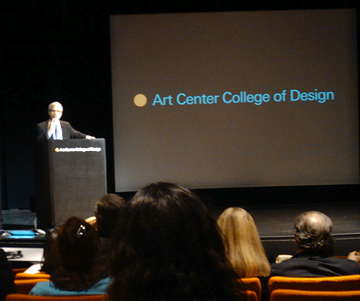
Good advice from famed cinematographer Owen Roizman, speaking at Art Center last Thursday as part of the Film Department’s Distinguished Filmmaker Series.

Roizman got his start in the business at a young age. His father was a cinematographer for Fox Movietone News, and he spent summers working at a camera rental store, where he became adept at threading film, taking apart cameras and putting them back together, and understanding the uses of various lenses.

After college Roizman sought employment in his chosen field—physics—and was dismayed to find the profession paid so little. He discovered he could make much more money working as an assistant cameraman, and a career was launched.

He ended up filming some of the world’s favorite movies: The French Connection, The Exorcist, Network, Wyatt Earp, Tootsie, The Taking of Pelham 123, True Confessions and many more.

His first film, Stop, was shot in Puerto Rico with a meager budget of $300,000 and was never released. From that, he got the job shooting The French Connection. Subsequently, he was known as a “gritty New York street photographer” even though he had never shot in that style prior to working on that film.

He expounded on some cinematographer’s tricks he used during the filming of that film, including how he force developed and underexposed the film to thin out the blacks and make them more milky.

His advice to students?

  • “Always do your best work: When this is edited together, no one will know it is 3 a.m. and you’re exhausted.”
  • “You always have to do the best that you can. You can’t let yourself fall to tiredness.”
  • “Whatever is on the screen, that’s you. That’s what counts.”

Statement on Japan by Art Center President Buchman

On behalf of the Art Center College of Design community, I would like to express our deep concern for the impact the devastating earthquake and resulting tsunami in Japan has had on all those affected by these tragic events.

Art Center has maintained close ties with Japan since the 1950s when the first design students sponsored by JETRO came to study at the College. In recent years, students from Tama Art University and Art Center have collaborated on several projects, including a study on earthquake safety, in an effort to design more effective approaches to education, preparedness and recovery. As we hear the news of this catastrophe, we are reminded of the common ties that bind those of us along the Pacific Rim.

Our shared vulnerability compels us to offer comfort; our long history provides a pathway to deliver it. Please know that we are reaching out to our many alumni, corporate and academic partners in Japan so that we can lend support where it is most needed. At the same time, we have dedicated resources to assist those students, faculty and staff on campus who are coping with losses from these events.

As the effects of Friday’s earthquake continue to unfold, our friends in Japan are foremost in our thoughts.  We mourn those who were lost and send our heartfelt wishes for a rapid recovery to all who survived.

Sincerely,

Lorne Buchman
President
Art Center College of Design

Image by designer Nick Nawroth. Prints are available for purchase, with half of the proceeds donated to the American Red Cross relief efforts in Japan.

* Editor’s note 3/16: Nawroth has contacted us to let us know that 100% of proceeds will be going to Japan relief efforts.

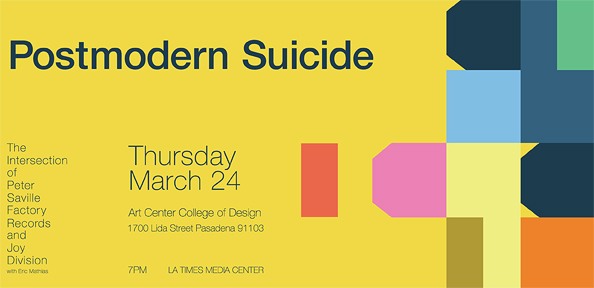
Postmodern Suicide: The intersection of Peter Saville Factory Records and Joy Division

Don’t miss a special guest lecture and discussion on graphic design history focusing on the influence of designer Peter Saville and Factory Records on postmodern design, along with an examination of the music and ideas that made this design phenomenon possible. The talk will lurch from Situationism in France in the late 1960s, to protopunk and punk rock in the ’70s , to the post-punk and new wave era of Joy Division, The Durutti Column, Cabaret Voltaire and New Order.

Guest lecturer Eric Mathias is a California-based graphic designer and Graphic Design alumnus. Born in San Francisco, Mathias is a creative consultant, art director and designer who operates his own design firm (National People’s Gang) and has served as frequent guest lecturer on Apple and Adobe products. In addition, he is a published news writer, editor and award-winning designer. His clients include AT&T, PBS and Disney.

The event is free and open to the public.

Postmodern Suicide: The intersection of Peter Saville Factory Records and Joy Division
With Eric Mathias
Thursday, March 24, 7 p.m.
L.A. Times Media Center


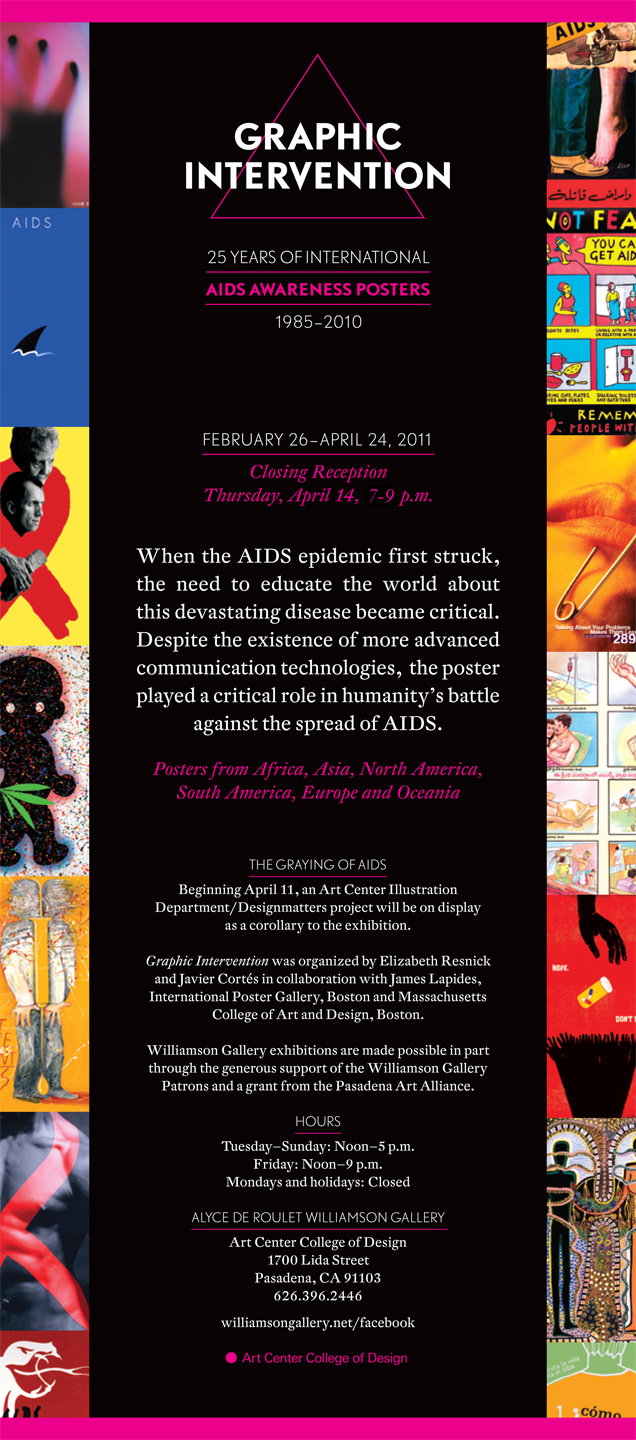
On Display: 25 Years of AIDS Awareness

When the AIDS epidemic first struck, the need to educate the world about this devastating disease became critical. Despite the existence of more advanced communication technologies, the poster played a critical role in humanity’s battle against the spread of AIDS.

Graphic Intervention: 25 Years of International AIDS Awareness Posters 1985—2010, now on display at the Williamson Gallery, is a traveling exhibition of more than 150 international AIDS awareness posters. This collection presents a compelling overview of the artists working within their personal cultural and national perspectives on the subject of AIDS.

The exhibition is on display at the Williamson through April 24, with a closing reception April 14. In April, an Illustration Department/Designmatters student project will be on display as a corollary to the exhibition examining the graying of AIDS.

More coverage:

Art Matters: Julie Deamer Speaks Tuesday

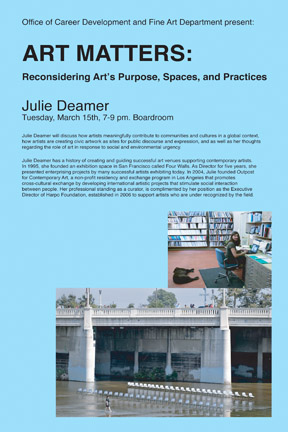
Julie Deamer will be on campus Tuesday to discuss how artists meaningfully contribute to communities and cultures in a global context as well as how they create civic artwork as sites for public discourse and expression. She’ll also share her thoughts on the role of art in response to social and environmental urgency.

Deamer has a history of creating and guiding successful art venues supporting contemporary artists. In 1995, she founded an exhibition space in San Francisco called Four Walls. Serving as director for five years, she presented enterprising projects by many successful artists exhibiting today. In 2004, Julie founded Outpost for Contemporary Art, a nonprofit residency and exchange program in Los Angeles that promotes cross-cultural exchange by developing international artistic projects that stimulate social interaction between people. She is also executive director of Harpo Foundation, established in 2006 to support under-recognized artists.

The event is free and open to the public.

Art Center’s Office of Career Development and Fine Art Department present:
ART MATTERS: Reconsidering Art’s Purpose, Spaces and Practices
Julie Deamer
Tuesday, March 15, 7-9 p.m.
Hillside Campus Boardroom

Learn to Create. Influence Change.

Art Center President Lorne Buchman unveiled Art Center’s new strategic plan last night to the College community. (Read our live tweets for the event on Twitter.)

The five-year strategic plan represents the culmination of more than a year of deep conversations, brainstorms and working group sessions with the entire Art Center community—students, faculty, staff, alumni, trustees and friends—that explored the intrinsic qualities of the great art and design college of the future. A website has been created as well that will explain the plan and track progress.

Also revealed was the College’s new mission statement: Learn to create. Influence change.

The strategic planning process coincided with the first full year of Buchman’s tenure, as well as the College’s 80th anniversary and related celebrations. The timing of this process gave the community opportunities to consider the College’s distinguished past while embracing the future.

Art Center’s five-year strategic plan offers a roadmap for getting there. The plan is organized into three broad pillars that align with Art Center’s mission: “The Conservatory Spirit,” “Convening Diverse Communities & Disciplines” and “New Spaces for Learning.”

The Conservatory Spirit
The first pillar, “The Conservatory Spirit,” reflects Art Center’s longstanding commitment to serve as the foremost college of higher learning for ambitious artists and designers to master their craft and learn from experts in their respective fields. To ensure Art Center’s programs remain on the leading edge and that students are prepared for leadership in a pluralistic society, the strategic plan calls for the expansion of transdisciplinary learning among students from different disciplines, as well as the creation of new undergraduate, graduate and public programs that will address emerging fields and provide students with additional opportunities for growth.

Convening Diverse Communities & Disciplines
The second pillar, “Convening Diverse Communities & Disciplines,” centers on the need to nurture a diverse and robust College com-munity of students, faculty and staff (in terms of culture, identity and socio-economic status.) Increasing the number of student scholarships is but one vital aspect of creating a more diverse community on campus. In addition, Art Center plans to offer a broader range of disciplines and partnership opportunities with industry and nonprofits that will aid in students’ creative development.

New Spaces for Learning
Equally important, students must have access to the types of learning environments—both physical and online—that will foster collaborations among the various art and design disciplines. The plan’s third pillar, “New Spaces for Learning,” calls for the improvement and development of Art Center’s South Campus in downtown Pasadena as well as a thorough renovation of the College’s Ellwood Building at Hillside Campus to replace outmoded and inefficient systems and materials. The plan also calls for the creation of online education programs and tools to expand and support curriculum and encourage new modes of learning.

Through these various initiatives and resolutions, the strategic plan will position Art Center to shape and define culture, to encourage relevance and social responsibility in art and design, to prepare graduates for leadership roles in society, and to advance learning, research and making. Our collective efforts, together with support from our partners and advocates, will make Art Center the leading college of art and design for the 21st century.

The full text of Art Center’s 2011–16 strategic plan is available online at artcenter.edu/createchange. Also, check out our live tweets from the event.