Category Archives: Designmatters

A bold LEAP in an emergent field: “Creative citizens” forge new pathways in design and social innovation

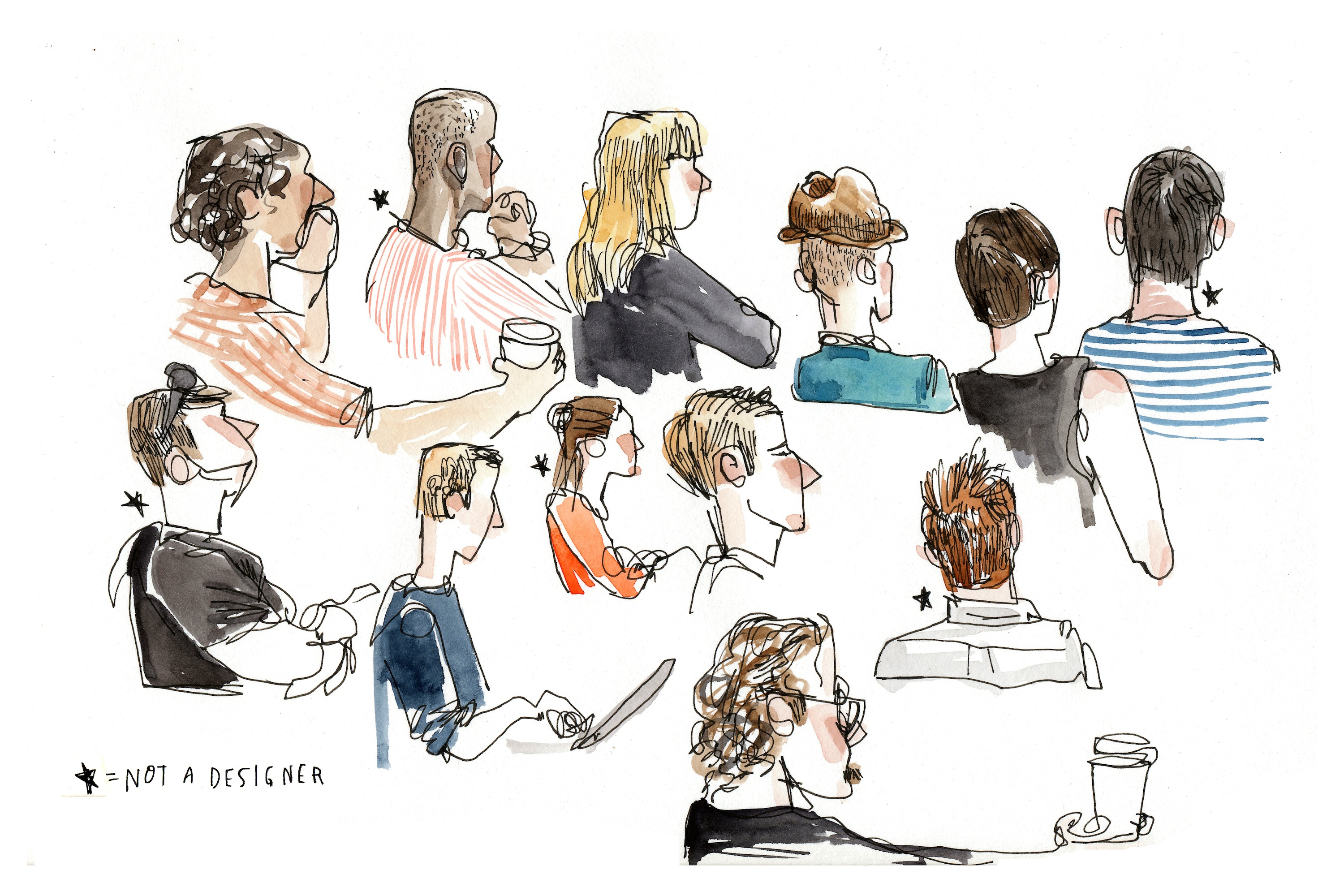
© 2013 Wendy MacNaughton for LEAP Symposium

© 2013 Wendy MacNaughton for LEAP Symposium


Editor’s note: This is the first in our Dotted Line series of three stories from “The New Professional Frontier in Design for Social Innovation: LEAP Symposium,” hosted by Art Center College of Design, Sept. 19–21, 2013.

__

Can design propel social change? If reducing infant mortality risk from HIV in Africa or improving rice crop outcomes among low-income farmers in Asia are any measure, the unequivocal answer—as participants in a three-day immersive symposium at Art Center amply demonstrated—is yes.

Less definitive are answers to the question that prompted the gathering: If I am a designer interested in this kind of work, what kinds of career pathways are available to me?

Organized by the College’s social impact department Designmatters with curatorial contributions from a “braintrust” of pioneers in the rapidly emerging field of design for social innovation, the LEAP Symposium kicked off September 19 at Art Center’s Hillside Campus in Pasadena, giving more than 100 invited participants from across the country an opportunity to examine current professional practices, values and opportunities; share challenges and successes; and envision possibilities for the future.

Why LEAP?

“To leap is not to move timidly, but to advance with great determination,” said Mariana Amatullo, co-founder and Vice President, Designmatters, in her opening remarks in Ahmanson Auditorium. “Design offers an unmapped frontier for social innovation, and the symposium is intended to serve as a platform for creative leaps into that space.”

Amatullo noted that the symposium would be “seeded with probes and what-if scenarios” and that honesty was the most important element of the “genuine conversation and free exchange of ideas” she hoped to foster. She also thanked the many individuals, organizations, companies, networks and foundations that made the LEAP symposium possible, including The National Endowment for the Arts and the Surdna Foundation, along with private sector partners Steelcase, Adobe, Sappi and Autodesk.

She posed three main questions as a point of departure for LEAP: What is design for social innovation? How does it manifest? Why does it matter?

“This is a time when we recognize a sense of urgency for social change to happen—perhaps on a broader scope than ever before—and with it, a call for path-creating forms of collaboration, and generative modes of intervention,” said Amatullo.

Participants, comprised of 60 percent designers and 40 percent non-designers, ranged from leaders at global NGOs and design firms to still-in-school designers directing their education toward social innovation.

Students officially made up 10 percent of participants, but at LEAP, everyone was there to teach, and everyone was there to learn. Continue reading
LEAP Symposium kicks off with a line-up of pioneers in design and social innovation

LEAP_web-banner_ART_01a

One hundred thought leaders and educators in design and innovation will converge at Art Center College of Design September 19–21 for the LEAP Symposium, a convening comprised of a series of focused conversations exploring new career pathways for designers in the emerging field of social innovation. For more information about LEAP, including participant photos and bios, please visit the newly launched website.

The weekend-long symposium was conceived and hosted by Mariana Amatullo, Vice President, Designmatters Department with a national braintrust that includes: Allan Chochinov, Chair Products of Design, School of Visual Arts and Partner, Core 77; Lee Davis, Scholar-in-Residence, Center for Social Design, Maryland Institute College of Art (MICA); William Drenttel, Director, Winterhouse Institute and Edirorial Director, Design Observer and LEAP Symposium Editorial Director; Robert Fabricant, Vice President of Creative, frog; Jocelyn Wyatt, Co-Lead and Executive Director, IDEO.org.

Portions of the event are open to students, faculty, staff and members of the public. Check out the schedule below. And if you can’t attend in person, you can also tune into the livestream of LEAP’s opening session and LunchTime Talks here.

Continue reading

Step in to the shoes of homeless youth with Media Design Practices


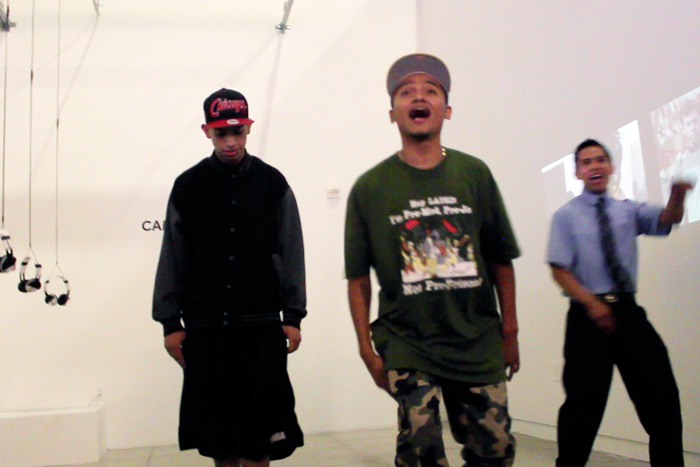
Performing their song, "The Road I Walk," at the gallery are from left, Marlon "Mr. Stranger," Kevin "Lil' Krazy aka Ghetto Boy" and Lorenzo "Mr. L.A."

Performing their song, “The Road I Walk,” at the gallery are from left, Marlon “Mr. Stranger,” Kevin “Lil’ Krazy aka Ghetto Boy” and Lorenzo “Mr. L.A.”

The road I walk every day, it’s no game,

I try to make my way.

 People see what they want to see.  

But that person is not me. 

Look at me, look at me…

I might surprise you. 

Who am I?…

Lyrics by Kevin Lil’ Krazy aka Ghetto Boy from the song The Road I Walk

The assignment for the first term Graduate Media Design Practices Field students was to use design to tell a story that reframes preconceived ideas of homelessness. One of the results was a powerful collaboration that asks viewers to “step into my shoes” to explore homelessness through stories told by youth who have been there.

In partnership with Jovenes, Inc., a nonprofit organization that provides housing and support services for homeless youth in Boyle Heights, three Art Center student teams got to work.

Continue reading

Pasadena green-lights Art Center student’s design for Armenian genocide memorial

Catherine Menard’s design for the Pasadena Armenian Genocide Memorial.

This week the Pasadena City Council unanimously approved the memorial designed by Art Center Environmental Design student Catherine Menard. The Los Angeles Times reported that more than 150 supporters attended the Sept. 9 meeting, including members of Pasadena’s large Armenian community.

Menard’s design concept was selected by the Pasadena Armenian Genocide Memorial Committee (PASAGMC) in January, at the conclusion of a two-phase competition. The monument will be built at a proposed site in Pasadena’s Memorial Park once PASAGMC completes its fundraising campaign. Dedication of the public artwork is set for April 2015, coinciding with 100th anniversary commemorations of the Armenian Genocide.

Related:

Art Center student wins Pasadena Armenian genocide memorial competition

How Alex Cabunoc set out to save the world, one laundry load at a time

Visitors to Art Center’s homepage may have found themselves wondering if that Brady Bunch-like grid of student selfies splayed out on Art Center’s homepage was some kind of post-modern meditation on ’70′s pop culture. And they’d be wrong. The real explanation —  a refreshed batch of student profiles — is a lot like Art Center itself: A practical solution to a real world need whose outcome is a lot more interesting than anyone might have expected going into the project.

Over the next few weeks, we’ll be rolling out a series of deeper dives into the creative lives of those profile subjects, with highlights from the body of work they’ve produced at Art Center. We’re kicking off the series with this look at Product Designer Alex Cabunoc’s truly impressive array of innovative social impact designs aimed at improving the lives of inhabitants rural communities in the developing world. For the project featured in the above video, Cabunoc teamed up with fellow student Ji A You to create the GiraDora foot-powered washing machine for a Designmatters challenge to alleviate the water shortage in Lima, Peru. The product he produced has vast potential to improve the health and quality of life of women in water-poor communities throughout the developing world. In the below Q&A, Cabunoc provides some personal context to his Art Center journey.

Continue reading

Art Center in the News, July 2013

ad agency_glo1mtc4.2-1

Alumnus Jim Root, art director at Cramer-Kasselt, was featured in the Milwaukee Wisconsin Journal Sentinel.

From fuel efficiency standards changing the look of your car to top ranked film schools, from Gibson Guitartown to backyard beehive designs – here’s where you can catch up on any Art Center news you may have missed with our latest media roundup.

The Hollywood Reporter, “The Hollywood Reporter Unveils the Top 25 Film Schools of 2013” July 31, 2013: Art Center moves up from #23 to #15 in  annual film school ranking.

The New York Times, “Carlab Mixes Natural Gas and Gasoline for More Efficient Vehicle”  July 9, 2013: Transportation Design instructor Eric Noble featured throughout the Wheels blog about rethinking the size of the natural gas tank.

Continue reading

Aquatopia: Rolling in the deep with Grad Art alumna Jennifer West

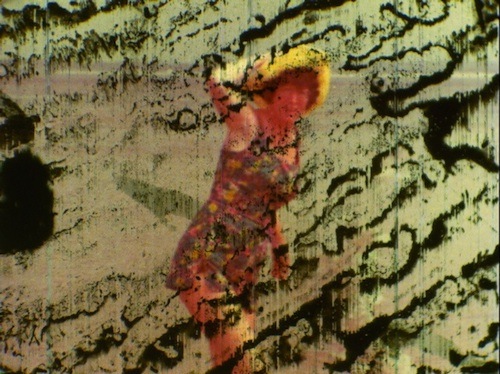
"Heavy Metal Sharks Calming Jaws Reversal Film" (2011) by Jennifer West. Super 8 print transferred to hi definition video with sound.

“Heavy Metal Sharks Calming Jaws Reversal Film” (2011) by Jennifer West. Super 8 print transferred to hi definition video with sound.

With 90 percent of the earth’s oceans yet to be explored, “the deep” is and has always been a place of mystery, fear, desire—and wild imagination. One Art Center alum who’s creatively plumbed this furtive, fertile territory is Jennifer West ’04 (Graduate Fine Art). Her recent multimedia work, “Heavy Metal Sharks Calming Jaws Reversal Film” (2011) is featured in Aquatopia: The Imaginary of the Ocean Deep, a major exhibition that opened this past weekend at the Nottingham Contemporary in Nottingham, England, continuing through September 22.

Bringing together more than 150 contemporary and historic artworks, Aquatopia explores how “the deep” has been imagined through time and across cultures. Sea monsters, sirens, sperm whales, giant squids, octopi, submarines, drowned sailors and shipwrecks are all portrayed. In a show that includes iconic works by JMW Turner, Odilon Redon, Hokusai, Barbara Hepworth and Oskar Kokoschka, West finds herself in prestigious company.

West is known for her digitized films that are made by hand-manipulating film celluloid, and the description of materials and processes she used to create “Heavy Metal Sharks Calming Jaws Reversal Film” tells a story in itself: “Faded pink super 8 film print — library copy of select scenes from “Jaws” — from Lorain, Ohio public library — treated with black fabric dye enriched with heavy metals: iron and zinc vitamins, celluloid grated with stone, whipped with hair headbanging, impressed with thumb and pink prints devil ears. Super 8 print transferred to hi definition video with sound.” Total running time: 6 minutes, 47 seconds.

In reviewing a previous show of the artist’s work, Wendy Vogel noted on Artforum.com, “Like her experimental predecessors, West forgoes narrative cohesion in favor of creating jumpy cuts and abstract visual collages — splicing, rolling, and drenching the celluloid using materials from Mylar tape to pickle juice, whiskey to candle smoke.” Writing on West’s work in Frieze, Joanna Kleinberg observed how “the intermingling of materiality, feeling and identity creates a wild blend of synaesthetic experience wherein the substances of life literally and figuratively colour the film.”

Born in Topanga, Calif., West lives and works in Los Angeles. Before earning her MFA at Art Center, she received a BFA from Evergreen State College in Olympia, Wash. She has had solo exhibitions in museums and galleries in Europe, Asia and the U.S., and has done commissioned projects for exhibitions at MIT’s List Visual Arts Center, the Aspen Art Museum and the Tate Modern. West also creates “zines” — DIY photo booklets of production stills of the making of her films — in conjunction with her exhibitions.

Curated by Alex Farquharson, Aquatopia is a collaboration with Tate St Ives in Cornwall, where it will be on view from October 2013 to January 2014.

“Like” Jennifer’s film on Facebook!

Nelson Mandela: Icon lost and regained

The work of three Art Center students was selected for the Mandela95 Poster Project

The work of three Art Center students was selected for the Mandela95 Poster Project

Today is Nelson Mandela’s 95th birthday. To commemorate this momentous event, a group of South African designers formed the Mandela Poster Project Collective, whose mission was to collect 95 posters for inclusion in a traveling exhibition which would ultimately be auctioned by the Nelson Mandela Children’s Hospital Trust. After receiving over 700 submissions from designers around the world, yesterday the committee announced the final collection of 95 entries, which includes the work of three Art Center students — Zarina Mendoza , David Iker Sanchez and Jasveer Sidhu — who developed their contributions as part of a Designmatters and Graphic Design collaboration under the creative leadership of Leonard Konopelski. 

To further honor Mandela’s vast contributions to human rights, we’re republishing the following essay by Amanda du Preez, professor of visual arts at University of Pretoria, paying tribute to the former President of South Africa’s role as a cultural icon and nonviolent global changemaker. 

Continue reading

The Collective Action Toolkit workshop equips designers and changemakers with versatile problem-solving techniques

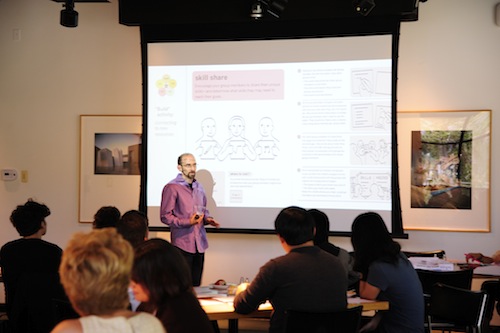
David Sherwin leads the Collective Action Toolkit workshop.

David Sherwin leads the Collective Action Toolkit workshop. Photography by Takayuki Mark Kasuya

“Go ahead and join a group.” This was David Sherwin’s opening directive to the students and faculty members spilling into Art Center’s faculty dining room for the Designmatters-sponsored Collective Action Toolkit workshop.  Sherwin, interaction design director and researcher at frog design in San Francisco, was not merely suggesting attendees sidle up to strangers. It was a non-negotiable requirement, which I discovered when I suggested I would not join a group because I only present to observe and report. “This is all about collaboration, so why don’t you find a group and participate?”

Roger that. Next thing I knew, I had wedged myself into a table full of students seated near the back of the room. We then embarked on our first assignment — writing our names and special talents on separate pieces of paper, which we’d then merge into one document listing our group’s core competencies. This exercise represents the Collective Action Toolkit’s first step in assessing the resources available to each collaborative cohort. In our case, we possessed an unsurprising abundance of design, drawing and drafting skills along with singing, writing and storytelling. Though we had no idea what task we would be asked to perform; it was hard, at that point, to see how this hodgepodge of talents would meld into a whole that was stronger than the sum of its parts.

Continue reading

Poster competition honoring Nelson Mandela features designs by eight Art Center students


Screen Shot 2013-07-10 at 2.07.52 PM

Organizers of the Mandela95 Poster Project suspected this would be an opportune time to commemorate Nelson Mandela’s contribution to humankind. But the project — a poster design competition conceived to align with Mandela’s 95th birthday on July 18 — may also serve a dual role as a eulogy to the anti-Apartheid revolutionary, who has been hospitalized since falling critically ill with a lung infection on June 8.

Posters designed by eight Art Center Graphic Design students, featured below, were selected for inclusion in the traveling exhibition by the South African Organizing Committee from a large pool of submissions from around the world.

Continue reading