Tag Archives: Space Travel

Alum Jessie Kawata merges design thinking and rocket science as NASA JPL’s visual strategist

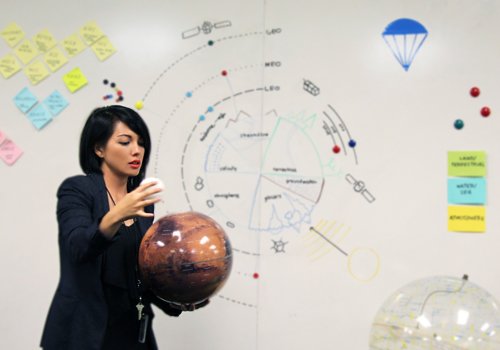
Jessie Kawata is a visual strategist at NASA + JPL

Jessie Kawata applies design thinking to scientific quandries at NASA + JPL


Jessie Kawata (BFA, Product ’11) is a Visual Strategist at NASA’s Jet Propulsion Laboratory, where she gets to stare into space for a living. This term she is teaching a Saturday High class at Art Center as well as mentoring students in Product Design’s Design for Sustainability 2 Studio class, which includes a NASA JPL theme using JPL’s Earth Mission and Climate Sciences data. Below she describes how she helps pave the way for design to exist in space exploration.

Continue reading

Art Center’s David Doody moonlights running mission control for NASA’S Cassini Saturn exploration


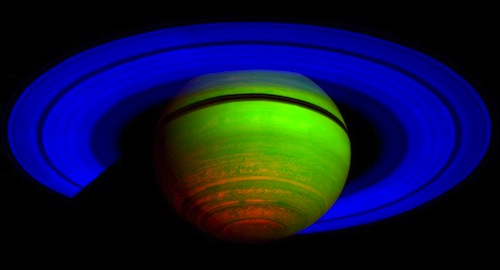
Cassini's ringed target: Saturn.

Cassini’s ringed target: Saturn.

“Right across the Arroyo, we’re making plans for a real close encounter,” says Dave Doody, whose Art Center At Night seminar, “Basics of Interplanetary Flight,” is currently recruiting participants for a class that’s literally out of this world. “My team has been piloting the gangly robot Cassini in wide orbits around Saturn since 2010. But in coming years we’re going to drop in for some up-close-and-personal visits. We’ll plunge the spacecraft between the rings and the planet 22 times before letting go of the spent machine so it can burn up in the gas giant’s atmosphere like a meteor.”

This 2016-2017 segment of Cassini’s 20 year mission has been temporarily dubbed the “Proximal Orbits” by mission planners at NASA’s Jet Propulsion Laboratory, where Doody works as a senior engineer, currently leading the Saturn-bound spacecraft’s flight operations controllers. But after acknowledging that some creative person somewhere could almost certainly conjure a more mission-worthy name, NASA launched the Cassini Name Game, hoping for some better ideas.

“One thing about these orbits will be their huge roller coaster speed,” says Doody. “The camera-laden craft will reach more than 120,000 kilometers an hour as it screams past the innermost ring particles just above the hazy atmosphere. Next, it’ll slow down for three and a quarter days, coasting ‘up’ to the top of its 1.2 million kilometer-high peak, before starting to drop back in again for its next pass. Wild.”

Continue reading

Dogs in Space!

David Wilson, director of the Museum of Jurassic Technology, visited Art Center on Monday to talk about the early days of the Russian space program.

Laika, painted by M.A. Peers, one of five portraits of Russian Space Dogs commissioned by the Museum of Jurassic Technology

Wilson was the final Big Picture Lecture Series speaker of the term. We knew right away that this talk was going to be an interesting one.

No talk of early Soviet space exploration is complete without a discussion of the Russian space dogs. As many know, Laika was the first earth born creature to leave the atmosphere.

We were amused and intrigued as Wilson taught us more about Russian space dogs. Did you know:

  • All were female.
  • All were formerly strays.
  • They went through extensive space training.
  • Nine dogs made it into orbit; sadly three of them died during their missions.
  • Strelka, who went into orbit with Belka, went on to have six puppies after her safe return to Earth. Nikita Krushchev gave one of the puppies to Caroline Kennedy in 1961.
  • Belka and Strelka are stuffed (!) and on display at the Cosmonaut Memorial Museum in Moscow.

Wilson also screened two portions of a film depicting the lives of early influencers of the Soviet space program. Obshee-Delo (translated means The Common Task)  told the stories of Nicolai Federov, who was an impoverished yet influential philosopher-librarian, and Constatine Tsiolkovski, who imagined the future of space travel.

Continue reading