Tag Archives: Tron

The future is spectacularly now in Product alum Edward Eyth’s concept art for “Back to the Future Part II”

Screen Shot 2015-01-23 at 11.21.58 AM

Today, Buzzfeed published the following photo essay, featuring Product Design alum Edward Eyth’s “Back to the Future Part II” concept art. The piece offers a prescient glimpse at the 1988 sketches of the futuristic world of 2015. What better way to kick off the weekend than by looking back at an Art Center alum’s vision for the future that is now.

Continue reading

“Tron” at 30: How Art Center Helped Power the Grid

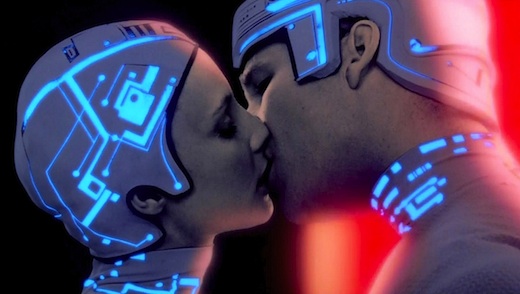
A tender moment from "Tron," which this year celebrates its 30th anniversary.

This year marks the 30th anniversary of Disney’s Tron, the movie which introduced a generation to light cycles, identity discs and a glowing spandex-clad Jeff Bridges. It was also the first time most filmgoers marveled at computer-generated special effects.

The history and evolution of Tron wouldn’t be the same without the work of a number of members of the Art Center community who were involved in the groundbreaking film, its 2010 sequel Tron: Legacy and the current Disney XD animated series Tron: Uprising.

To celebrate three decades of “the grid,” let’s take a look at how Syd Mead TRAN ’59, Eric Barba TRAN ’92 and current Entertainment Design student Annis Naeem helped shaped Tron’s digital frontier. Continue reading

Catching Up With Syd Mead

As the buzz around Tron: Legacy reaches a fever pitch leading up to its opening this weekend, our thoughts naturally turn to the original Tron and our beloved alumnus Syd Mead, whose designs are synonymous with the groundbreaking film.

A 1959 Transportation Design graduate, Mead is best known for his work on Tron, Bladerunner and Aliens, as well as for the creation of the V’Ger for Star Trek: The Motion Picture.
Mead

We caught up with Mead this week to find out what he’s been up to, and his thoughts on the new Tron.

Dotted Line: You’ve been busy. Tell us about your latest projects.
Syd Mead:
My latest complete project was two food service designs and installations in New York City. FoodParc at ground level off Sixth Avenue and Bar Basque, the second level lounge and restaurant. My designs started, literally, on 8.5” x 11” sketch paper on the way back from New York after the first meeting with the architects, Philip Koether, Architects. The designs were faithfully reproduced by Koether’s expert team. Concept moves to completion through a complex symphony of cooperative expertise.

In the movie field, I’ve just completed pre-production contract designs for a young, recognized director for a movie title that is in progress. It is not my position to tell what it is.

Dotted Line: What have been the most enjoyable aspects of these projects?
Mead:
They’ve all been enjoyable because you learn from each cooperative venture. The surprises come as the project moves from concept to idea to design. Adaptation to end format protocols, unwelcome shifts in focus by either capital sources for the project or intrusion into the process by those unfamiliar with the project intent yet given authority to “change.”

Dotted Line: Tell us about your current work in your new book, Sentury II. Has your focus changed over the years?
Mead:
As a follow-up to Sentury, Sentury II covers the last 10 years of professional enterprise. My focus? It’s not changed for more than 50 years. The tools that accomplish the various desired results change; the methodology does not. The mistake I see in current rush to the computer is that the tool becomes more important than either the idea or the technique. This is disastrous.

Dotted Line: What interests you these days?
Mead: I have been interested in the development of a tool. We now have semi-intuitive “helper” software that anticipates habitual use of various software features. The hazard is that you come to depend on those “conveniences” to the detriment of genuine creative use of the exotic software being used. And, with many software applications, you aren’t given specific “turn off” directions. Another fascinating drift is the increasing insistence that since work is being done on a computer, the professional fee structure should be downgraded to a time/result formula rather than a realization that the computer implementation is a tool function, not a creative front-end function. Financial vectors in most professional account sources simply don’t recognize the difference between the two.
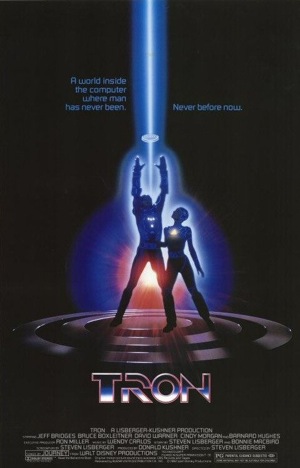
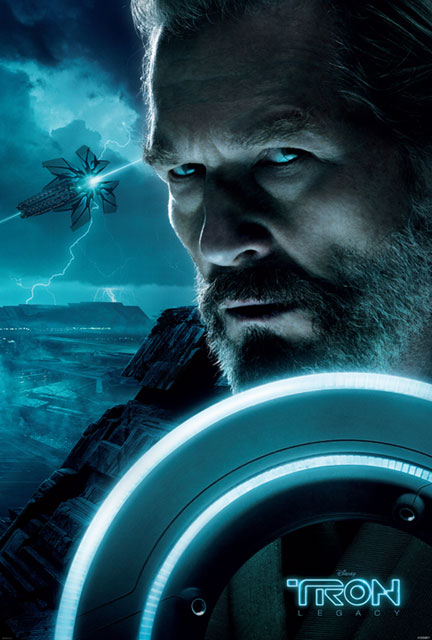
1982 poster for Tron

Dotted Line: With the buzz surrounding Tron: Legacy, our thoughts naturally return to the 1982 Tron that you worked on. Can you share with us what that job was like?
Mead:
For the original Tron I designed the tank, the aircraft carrier (Sark’s command ship), the interior control set for the recognizer, the light cycles, of course, the release graphics of the movie title, the rotating CPU, the CPU approach field, the game arenas, the holding cells for the players, Sark’s command camp pit, Sark’s command pedestal and backup and several set drawings used to create the story environment including Yori’s apartment and the scenery design for the tank chase.

I was invited for lunch on the Disney lot by producers Steven Lisberger and Don Kushner and received a book of stuff that Steven already had with him. I started after about two or three weeks after contract matters had been agreed to by Disney.

I worked on Tron from my home studio, as I have with all the movies I’ve worked on. I always have several projects going through the corporation and being sequestered in an “on lot” cubicle doesn’t work. My function is meta-staff working one-to-one with the director and his immediate authority, the production designer.

Continue reading

A Legacy Revisited: Art Center Alumnus Eric Barba Envisions the World of Tron

For Art Center alumnus Eric Barba, things didn’t seem like they could get any better after he won an Oscar for his groundbreaking special effects work on The Curious Case of Benjamin Button. That is, until he got the gig overseeing the special effects for Tron: Legacy, opening this weekend.

Courtesy of Disney

For Benjamin Button, Barba was tasked with making Brad Pitt appear older. For Tron: Legacy, his challenge was the opposite: to make a present-day Jeff Bridges appear as he did in the 1982 original. And, it had to appear authentic. Add to that the intense pressure of a cult-status 1982 film Tron (visualized by another Art Center alum, Syd Mead, who we also spoke to this week), and Barba had his work cut out for him.

Barba has been with the SoCal-based Digital Domain visual production studio for 13 years, and like many of the top directors he collaborates with, he’s equally comfortable working in film or advertising. He started at Digital Domain as a digital artist on The Fifth Element and CG supervisor on Supernova before rising to visual effects supervisor for David Fincher’s Zodiac.

As we count down to the opening of Tron: Legacy, the Dotted Line caught up with Barba to talk about his work as visual effects supervisor on this much-anticipated movie, his work and, of course, Art Center.

Dotted Line: How was working on the new Tron film different from others you’ve worked on?
Eric Barba:
This was the most difficult project I’ve ever done, for many reasons. It was by far the most challenging. The work we had done on Benjamin Button was considered the holy grail of special effects because we were aging a human face, which hadn’t been done before. The [Jeff Bridges] character Clu pushes that envelope so far, and so much faster, than we expected. We didn’t know that these sorts of effects [such as portraying a decades-younger Bridges] were even possible to do. And working in 3D was new for me, too.

Dotted Line: What are the different considerations when working in 3D?
Barba:
It’s incredibly challenging technically, because we’re still in the early stages of learning how to shoot 3D from a how-the-camera-works standpoint. I like to joke that the camera we used to film this will be in a museum at some point as a relic, because if you look at it, it’s actually two cameras strapped together.

And because of this there are a lot of technical challenges and mechanical imperfections, lens imperfections and the like. You have to continuously fix things and put stuff back together. For example, when we’re trying to shoot two actors playing a disc game, if they don’t stand in the correct space on a 50-foot screen, then the shot is ruined. All the techniques we use for tracking—making sure our CG and our studio camera line up—have to be rewritten because they have to be much, much more accurate for 3D. And you have to render everything twice, so it’s twice the disk space. Then you have to have development systems to look at it and judge it. It definitely raises the bar as far as technical difficulty.

Continue reading