Category Archives: General Interest

Art Center Racks Up Art Directors Club Awards

More great award news—the 2011-2012 Art Center Viewbook has won a Silver Award in the Art Directors Club 90th Annual Awards competition in the Professional Book Design category.

Judged by an international panel of the world’s most respected creative professionals, the ADC Annual Awards competition honors the best design from around the world in interactive media, broadcast and print advertising, graphic design, publication design, packaging, photography and illustration. The Viewbook will be included in the Art Directors Annual, the oldest and most respected compendium of outstanding work in the industry. The Viewbook will be on display at the awards presentation in New York and will then be included in the Art Director’s Club exhibitions that travel throughout North America, Europe, Asia and South America.

But the Viewbook wasn’t the only winner—the Safe Agua Chile book produced by Designmatters won a Merit Award in the Student Book Design and Student Motion categories, and the Cymatics exhibition garnered a Bronze Award in the Student Branding category. The Fly Title Sequence won a gold in the Student Motion category.

Congratulations to all for these well-deserved honors!
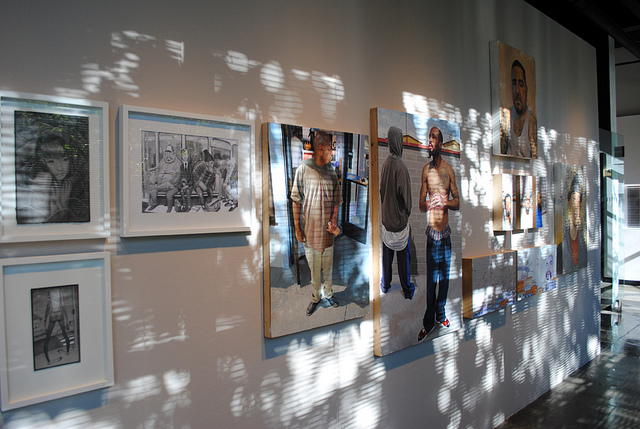
Art Center Opens Its Doors for ArtNight

Photo by Lara Warren

Save the date: ArtNight is Friday, May 20.

Enjoy a free evening of art, music and entertainment as Pasadena’s most prominent arts and cultural institutions swing open their doors.

In addition to Art Center, participants include the Norton Simon Museum of Art, Pasadena Museum of History, the Armory Center for the Arts, and many more.

Last fall, 14,000 people experienced the excitement of ArtNight—why don’t you check it out this spring? For more information, call the ArtNight Pasadena Hotline at 626.744.7887 or check out the ArtNight Pasadena website.

ArtNight Pasadena
Friday, May 20, 6-10 p.m.

The Myth of the Starving Artist

Just about every art and design student has had their pursuit of a career in the arts questioned by someone at some point in time.

© Steven A. Heller/Art Center College of Design

But a new national survey reports that graduates of arts programs are likely to find jobs and personal satisfaction, according to an article in Inside Higher Ed.

From the article:

The results of the survey, which are being released today, may offer some measure of succor to parents who are anxious about their children’s artistic aspirations.

And, while the survey may help arts programs defend against accusations that they produce an oversupply of soon-to-be-discouraged artists, they also suggest areas—particularly in the area of career preparation—in which these programs can improve.

Read more:
The Myth of the Starving Artist

The Limits of Control

Ask Art Center faculty and alumni what changes they think the next 80 years of art and design will bring, and you’ll get no shortage of compelling answers.

Autonomous cars! Augmented reality! Networked schools of fish! (No, I’m not making that last one up.)

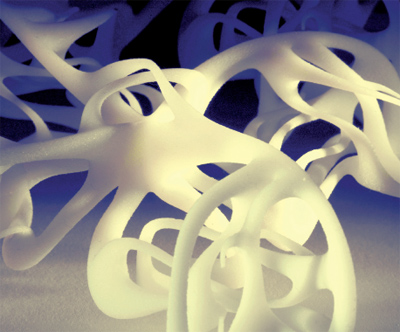
David Erven, Dihedral Tile, detail (2008)

All topics worthy of in-depth exploration, but there’s one emerging trend that keeps kicking at the door. It’s a trend that appears across many disciplines and fulfills deep-seated human needs, ensuring it won’t be going away anytime soon.

This trend doesn’t have a name per se. It goes by many names: DIY (“Do it yourself”), hacking and open-source are just a few of its monikers. Whatever you call it, this trend represents a paradigm-shift for the creators of intellectual property.

It’s a trend where end-users are increasingly expecting more control over their products and experiences, and where creators are shifting from designing finished products to designing spaces where user-driven expression can occur.

And it’s a trend, which—although it has numerous historical antecedents—is about to explode thanks to both current technology and technology just around the bend.

Read more of this story at the DOT magazine website.

More from Syd Mead on Sentury II

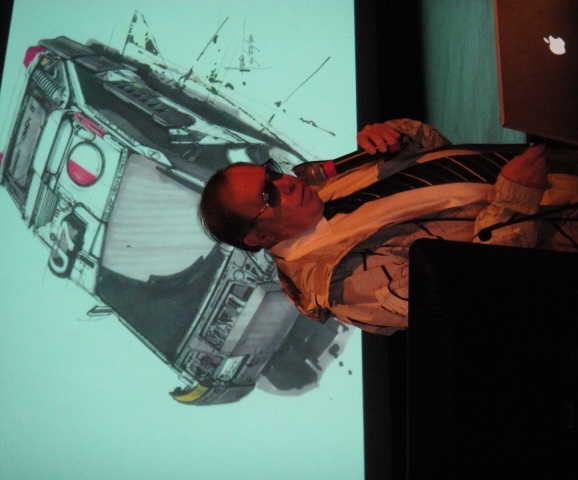
Legendary visual futurist and Art Center alumnus Syd Mead stopped by Art Center last month as part of the Design Studio Press Spring Lecture Series.

Mead and his "Blade Runner" Spinner vehicle.

His lecture traversed the history of automobile design, the future of transportation, his early work for Ford and U.S. Steel, his work on Blade Runner and his latest book Sentury II.

We followed up with the designer via email to ask him about Sentury II.

Dotted Line: You mentioned in your lecture that the cover of Sentury II is intended to look like a metallic artifact that might be found in the future. What’s happening in the scene depicted in the artifact?
Mead:
On the left of the spine of the book is a series of manifolds, circuitry and panels that simulate the energy feed to the image coherent side at the right (the actual cover of the book). I show a stylized, ceremonial figure just to the right of the book spine (the center of the overall artwork) and a horizontal split that reveals an energy source (heat? photon glow?) from behind the front surface of the plate combination.

At far right, just above the glowing energy source horizontal is a tableaux of figures and fixtures. One figure is entering a vehicle of some sort while behind him are a series of figures depicting a montage of social interaction, stylized foliage and geometric alignments that eventually go parallel to the outer edge of the ‘artifact.’

I imagined that this entire piece might have been dug up, cleaned off and somehow energized to bring the overall surface detail into view. The overall look of the cover art is a deliberate homage to the cover of Sentury II, which I painted first.

The cover of Sentury II

Continue reading

Open Market This Sunday

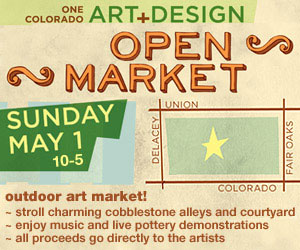
This Sunday is the Art & Design Open Market at One Colorado.

Open Market is free and open to the public. It allows a rare opportunity to purchase prints, photography, sculpture and fine art created by students, faculty and alumni form Art Center and PCC. All of the proceeds from sales will go to the artists.
Since its launch in 2003, the Open Market has provided visibility for more than 700 artists and has served as a destination for thousands of art collectors and enthusiasts. Art for sale includes photography, fine art, paintings, illustrations, graphic design, ceramics, sculptures and more. For photos of the Fall 2010 Open Market, click here.

For more information, visit onecolorado.com or call 626.564.1066.

Art + Design Open Market
Sunday, May 1, 10 a.m.-5 p.m.
One Colorado
24 East Union Street, Pasadena, CA 91103

Grad Show Preview in Pictures

It’s pretty quiet on campus here today after a whirlwind few weeks leading up to the end of Spring Term and Saturday’s Graduation.

Enjoy this slideshow of images from Thursday night’s Grad Show Preview, featuring work of graduating students:

MDP Students Create Installation for A+D Museum

The following post, written by faculty member Phil van Allen, is reprinted from his blog.

View Slideshow

Recently a few of my students from the Media Design Program at Art Center and I created an interactive video installation for the 10th anniversary of the Architecture+Design Museum.

The A+D is a growing institution in the Los Angeles area, and they were having a party for their board and major donors. Two weeks before the event I got a call from museum supporter Garson Yu owner of yU+co, asking to help out in a volunteer effort to create something to show the history of the museum. By the time I got some students to sign up, and an approach approved, we had just one week to make the entire project.

The project consists of six plywood panels mounted to the wall, with separate slideshows running on each panel. Because the panels are different distances from the wall, there’s a dimensional effect created.

The idea was to break the normal flat rectangle of projection and create an installation that felt more like a physical part of the space. In addition to the randomly playing slideshows on each panel, we created a simple interactive feature so if someone walked up to the wall, a flourish of motion graphics would appear unifying all the panels, then fading into a photo of the front of the museum spread across several panels.

The project was a collaborative design and build between myself and three students: Brooklyn BrownManny Darden and Rubina Ramchandani. The design approach was partially inspired by some of Manny’s thesis work.

For software, we used my NETLab Toolkit with a new SlideShow widget I developed that runs each of the slideshows - the entire project has no ActionScript, using only the toolkit widgets. Images were placed in folders, and each SlideShow widget played a set of images from these folders in a random order. Two projectors were used to get a wider display (2500 pixels), and these were fed by a video splitter out of a MacBook Pro (this way the Flash movie played across both projectors). An Infrared proximity sensor was used to detect someone in front of the wall, and this started the playback of five different video streams across the different panels.

View videos of the project on van Allen’s site.