Category Archives: General Interest

Visual Acoustics Screening Sunday

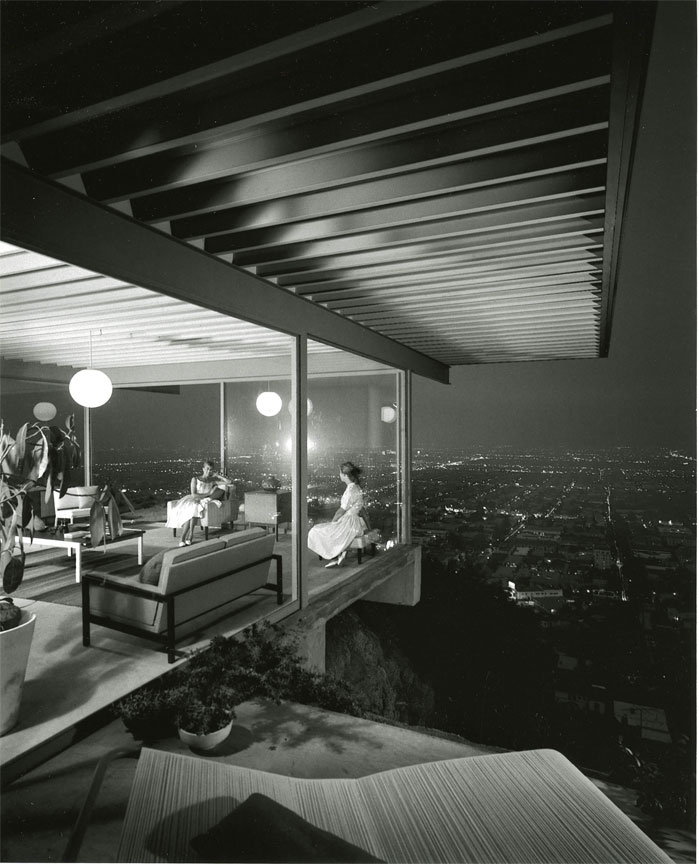
Grassroots think tank One Community, in association with the Julius Shulman Institute at Woodbury University, will present a screening of the film Visual Acoustics: The Modernism of Julius Shulman at Hillside Campus Sunday. The documentary will be followed by a moderated discussion—Does Architecture Create Great Communities or Do Communities Create Great Architecture?—featuring architectural historian Barbara Lamprecht and artist Michael Stern.

Narrated by Dustin Hoffman, the film explores the monumental career of architectural photographer Shulman, who died last year at the age of 99. Shulman combined the organic with the synthetic, capturing the essence of urban design and nature in his photographs.

The event is free and open to the public. RSVP at onecommunitythinktank.com or onecommunitythinktank@gmail.com.

Screening: Visual Acoustics: The Modernism of Julius Shulman
Sunday February 28, 4 pm
Hillside Campus
Ahmanson Auditorium

(Pictured: Case Study House No. 22, Julius Shulman)
In Case You Missed It…

As you know, there’s always something going on when it comes to Art Center alumni, students and faculty. Some of the latest:

  • Did you know that the “Godfather of Paparazzi,” Ron Galella, is an alum? the {warehouse} magazine
  • Illustration alumnus Tavis Coburn created a series of incredibly cool posters for last week’s BAFTA (British Academy of Film and Television Arts) Awards. (Pictured) /Film
  • The New York Times takes at look at the 2010 Acura ZDX, created by Transportation Design alum Michelle Christensen four years ago, while she was still a student here.  Also integral to the project were several alums: project leader Damon Schell TRAN ’99, interior designer Michael Wiedeman TRAN ’97 and color and trim designer Kimberly Marte ENVL ’99. New York Times
  • More on the upcoming Williamson Gallery DreamWorlds exhibit. Pasadena Star-News
  • Illustration alum Ajmal Zaheer Ahmad recently unveiled the FireBreather, a custom 2010 Camaro created for the upcoming supernatural thriller Jinn, which Zaheer is directing. AutoBlog
  • Photographer, alumnus and faculty member David Sotelo braves downtown L.A.’s shuttered El Dorado Hotel. GOOD
  • Faculty member Annette Weisser’s latest exhibit, The End of the World, opens Friday at Reception Gallery in Berlin. reception-berlin.de

MDP Graduate Thesis Project Goes Viral

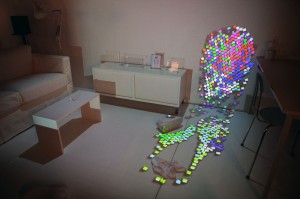
Graduate Media Design alum Julia Yu Tsao’s graduate thesis project, Curious Displays, has gone viral, with mentions at Boing Boing, and Gizmodo and Loyal K*N*G, among many others.

“The project explores our relationship with devices and technology by examining the multi-dimensionality of communication and the complexity of social behavior and interaction,” writes Tsao, who graduated in December. “In its essence, the project functions as a piece of design fiction, considering the fluctuating nature of our present engagement with media technology and providing futurist imaginings of other ways of being.”

Check out the super-cool video after the jump.

Continue reading

Seymour Chwast Visits Campus

International design legend Seymour Chwast will be on campus tomorrow, February 25.

Chwast’s award-winning work has influenced two generations of designers and illustrators. Recipient of the AIGA medal, he co-founded Pushpin studios, which rapidly gained an international reputation for innovative design and illustration. Pushpin’s visual language arose from a passion for historical design movements and helped revolutionize the way we look at design today. Come and see the work, now collected by the Museum of Modern Art, and hear the story behind a lifetime of innovation and ideas. A book signing will follow the lecture.

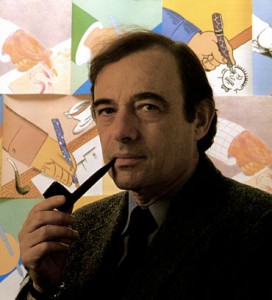
Seymour Chwast
Thursday, February 25, Noon
Ahmanson Auditorium

Words, Words, Words! Marion Bantjes brings her candor to Art Center

Marian Bantjes, fresh from her appearance at TED, stopped by the Ahmanson Auditorium last Thursday to share some riveting stories behind her internationally-recognized work. The Canadian artist, typographer, designer and writer touched on her project selection process, the philosophy behind her unique aesthetic and the difficulty of finding something worth saying.
Did you hear Bantjes speak? What did you think?

Here are a few highlights:

On her early career as a typesetter:

As a typesetter, I didn’t do any creative work at all. The designer told me what to do and my job was to know typography well enough to get it right. I did this for ten years. Most people who want to be designers think of this as tedious. But I learned a lot about typography and I loved that job. It’s something undervalued in most design today. People want to do the fun stuff, the crazy stuff, the stuff that I do now, but it’s really important to be able to get pleasure in the fine details.

Continue reading

Can Context Be Counterproductive in Art?

Miller-McCune reports on some surprising new research that suggests that presenting contextual information alongside a work of modern art may lessen a viewer’s enjoyment or appreciation of the piece.

From the article: “‘Providing contextual information led to participants perceiving examples of the various styles of art as matching less well with their internal standards than when no contextual information was presented,’ Bordens writes. In other words, they were more likely to feel a piece conformed to their personal ideas about art — and thus more likely to enjoy or appreciate it — when it was presented without interpretation.”

Do you agree? Can context be counterproductive?

Read the article: Context May Diminish Art Appreciation

EcoCouncil Meets the President

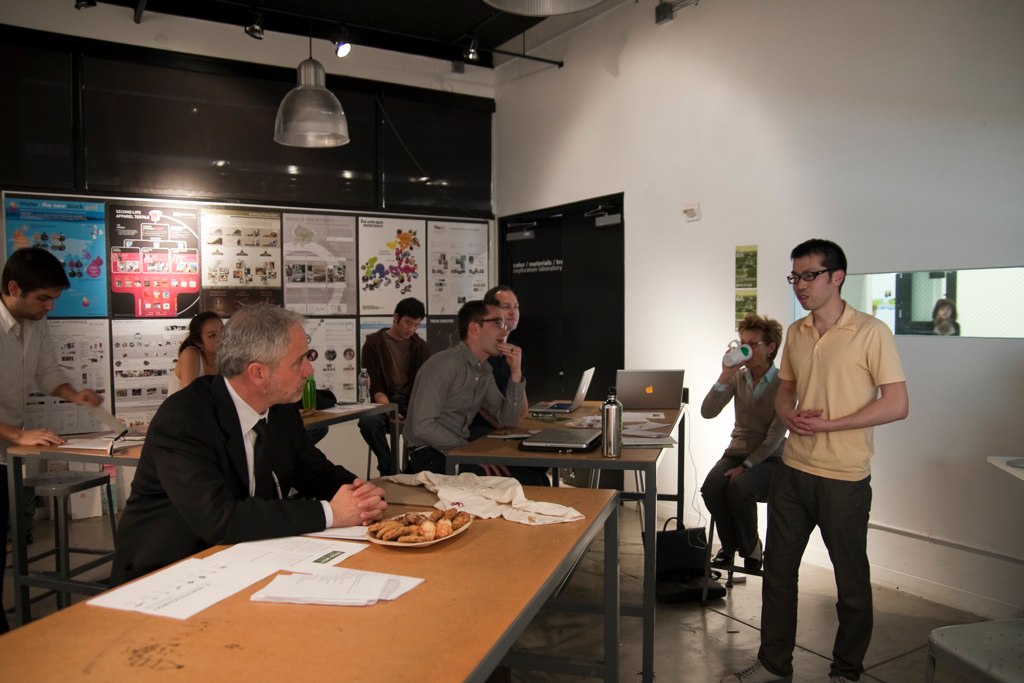
Art Center President Lorne Buchman recently met with the EcoCouncil, a student-run organization which works closely with faculty and administration to find practical and creative solutions to reduce the College’s ecological impact. The group conducted a presentation for Buchman outlining their vision for sustainability initiatives at the College, including their desire for required courses in responsible design for all students, improved recycling efforts on campus during peak periods of the term, increasing accessibility to public transportation, and finding better ways to maintain and incorporate the Art Center community into our hillside environment.

ARCOmadrid Honors Los Angeles

The 29th edition of Spain’s leading contemporary art fair, ARCOmadrid, has opened its doors. For the first time, a city—Los Angeles—is the fair’s “honored guest,” rather than an entire country.
From this month’s issue of Art in America: “The switch, says the fair’s director, Lourdes Fernandez, reflects the fact that ‘contemporary meaning is not in countries but in cities.’ … It probably doesn’t hurt that L.A. is full of collectors and galleries, very few of which participate in ARCO, representing a potential future constituency.”

Be sure to check out this interesting story on the fair’s opening day at artdaily.org and this great article on the L.A. galleries participating at the Los Angeles Times.

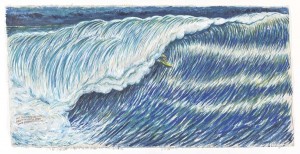
Pictured: No Title (His transformation is), by Raymond Pettibon

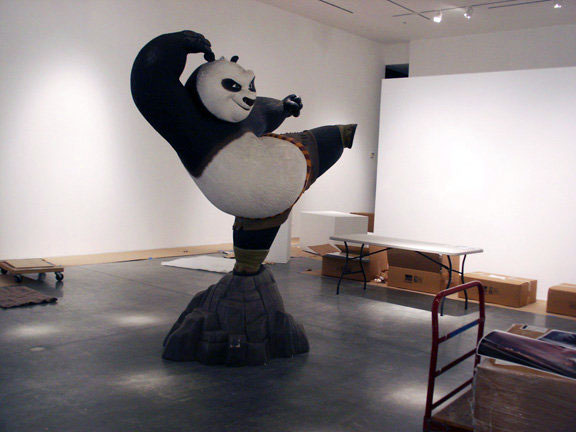
Po the Panda is Here!

Williamson Gallery Director Stephen Nowlin gives us a behind-the-scenes peek at the installation of the upcoming exhibit DreamWorlds, opening March 4. A partnership between the College and DreamWorks Animation, the exhibit will highlight the artistry and craftsmanship behind today’s most successful animated features.

Become a fan of the Williamson Gallery on Facebook for exclusive updates as the exhibit takes shape. And speaking of Facebook, the official College Facebook page has officially launched—become a fan today!

Battle Royale: Book Versus Web

Lawrence Weschler loves the Web. So why is it a problem, then?

Permanence, for starters. The “extreme perishability of digital information” is of great concern to Weschler, who spoke on campus last Monday as part of the Big Picture Lecture Series. “Cuneiform tablets and papyrus scrolls have lasted thousands of years,” he explains. “Digital information, on the other hand, is catastrophic.”

Weschler argues the problem is that digital information decays over time, as well as the equipment and software used. Floppy discs, VHS tapes, CDs—these disposable media forms are quickly becoming archaic, and the work they contain becomes lost forever.

“The entire Clinton administration, in terms of history, is gone,” Weschler says. “Almost everything was conducted via email, with devices that are no longer around to use.” (Not to mention the fact that an external hard drive containing copies of data from the administration was discovered missing by the National Archives and Records Administration in 2009.)

A second issue, according to Weschler, is the “palpable substantiality of books,” or the stability of a printed book versus the instability and frantic nature of the Web. Books have substance and soul, while the Web is filled with insubstantiality and soullessness. “There is no calm centeredness on the Web,” he says. “Just a frenzy of echoes that rebound and go from one thing to the next. Which is its great strength as well.”

There is another set of issues with the Web related to authors. “The value of publishing a book for a writer is much the same as a visual artist putting together an exhibition,” Weschler says. “Preparing for an exhibition forces artists to self-edit, take stock in their work and decide what was good and what wasn’t.” You can’t do this on the Web, he argues. “It’s just too easy to put things up without the proper foresight or editing.”

Continue reading